We're celebrating our new website -
and you get. . .
and you get. . .
A special 10% Off!
Simply enter LAUNCH10 at checkout to redeem your discount. Don’t miss out on this limited time offer!
Round cut engagement rings have held the top position for over a century, and the reasons have nothing to do with trends. As Vogue recently noted, the round brilliant cut remains the most requested diamond shape for engagement rings worldwide — and the explanation is rooted in physics, not fashion. This guide covers everything you need to know before buying a round cut diamond ring: how the cut works, what grades actually matter, how it compares to the oval, and which settings bring out the best in it.
More than half of all engagement ring diamonds sold globally are round brilliants. That figure has remained roughly consistent for decades, even as oval, cushion, and emerald cuts have cycled in and out of fashion. The reason is simple: the round brilliant produces more light return — brightness, fire, and scintillation — than any other diamond shape.
The modern round brilliant was developed in the early 20th century by Marcel Tolkowsky, a mathematician and diamond cutter who calculated the exact proportions needed to maximize light performance within a circular diamond. His 1919 paper, Diamond Design, established the proportion ranges that became the foundation of the Ideal cut grade. Unlike other diamond shapes, which were developed organically over centuries of craft tradition, the round brilliant was engineered from first principles for a single purpose: maximum optical performance.
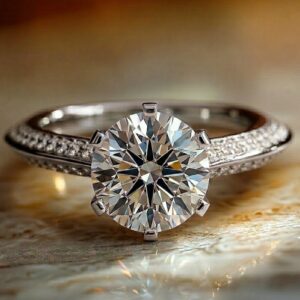
A standard round brilliant has 57 facets (58 if the culet — the bottom point — is faceted rather than pointed). These are arranged in a precise radial pattern: 33 facets on the crown (top half) and 24 on the pavilion (bottom half). The table — the large flat facet on top — acts as the primary window for light to enter. The surrounding crown facets redirect light toward the pavilion. The pavilion facets act as mirrors, bouncing light back up through the crown and out through the table toward the viewer’s eye.
When every angle is correct — when table percentage, depth percentage, crown angle, pavilion angle, and girdle thickness all fall within the Ideal range — virtually all incoming light exits back through the top of the stone. This is what produces the visual qualities buyers describe: brightness (white light return), fire (rainbow dispersion), and scintillation (sparkle when the stone or light source moves).
Cut grade is the most important of the four Cs for a round brilliant, and it is frequently misunderstood. Cut grade does not describe the shape of a diamond — it describes how precisely the facets, angles, and proportions were executed during the cutting process. A diamond graded Excellent or Ideal was cut to the proportions that produce maximum light return. A diamond graded Good or Very Good was cut to proportions that fall outside the optimal range, meaning some light leaks out through the sides or bottom rather than exiting through the top.
The difference is visible to the naked eye. An Ideal cut round brilliant in the same lighting conditions as a Good cut stone of identical carat weight, color, and clarity will look noticeably brighter, more lively, and more brilliant. The Ideal cut grade is awarded by IGI (and GIA’s equivalent “Excellent”) to a small percentage of round brilliants — the majority of diamonds cut globally do not achieve it.
For a round brilliant specifically, Ideal cut is not optional — it is the most important purchase decision you make. A 1.5ct Ideal cut will outperform a 2ct Good cut in almost every lighting condition that matters: restaurants, offices, daylight, photography. If you are going to spend money on a round brilliant, spend it on the cut first.
The oval brilliant is the closest alternative to the round, and the comparison is worth understanding precisely:
Neither is objectively better. Round maximises optical performance; oval maximises perceived size per carat. The choice depends on which variable matters more to the buyer.
The round brilliant’s 57 radial facets have an important side effect beyond light performance: they mask inclusions and color more effectively than any other diamond shape. The rapid, multidirectional light reflection keeps the interior of the stone visually busy, making it harder for the eye to settle on any single feature — including inclusions and color tints.
Clarity: A round brilliant can go lower on the clarity scale than any other shape while remaining eye-clean. VS2 and even SI1 are frequently eye-clean in round brilliants — inclusions that would be obvious in an emerald or Asscher cut are invisible in a round. This means buyers can allocate budget away from clarity and toward cut or carat weight.
Color: G and H color grades look completely white in a round brilliant set in yellow or rose gold — the warm metal creates a contrast that makes the stone appear even whiter. For white gold or platinum settings, F color or better is worth considering, as the neutral metal provides less contrast and makes any warmth in the stone slightly more detectable. In practice, most buyers choosing a round brilliant in yellow gold can choose G or H without any visible compromise.
The practical formula: prioritise cut (Ideal), then choose G-H color and VS2-SI1 clarity — and spend the budget saved on a larger carat weight or a better setting.
The round brilliant is the most setting-versatile diamond shape. Its symmetrical outline works geometrically with any frame.
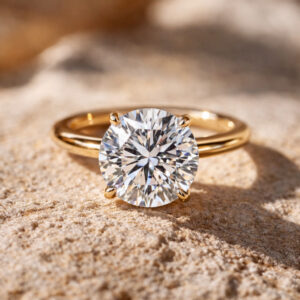
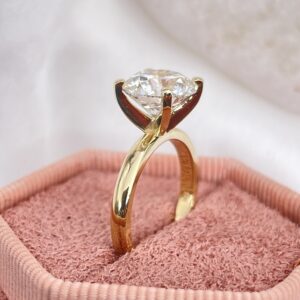
Solitaire: The most classic configuration. A single round brilliant on a plain or twisted band. The entire visual focus is on the diamond — which makes cut quality the most visible variable. A well-cut solitaire round is the definitive engagement ring.
Round halo: A circular border of accent diamonds surrounds the center stone at the same geometric level. The halo follows the round outline perfectly, adding significant visual size (a 1.5ct round in a halo reads as larger than a 2ct round solitaire) and providing a second ring of sparkle around the center. See our 2 Carat Round Lab Diamond Halo Ring.
Cushion halo: A rounded, pillow-shaped frame replaces the circular halo. The cushion halo adds a softer, more vintage feel while still being geometrically appropriate for a round center. The rounded corners of the halo echo the circular outline of the stone while adding dimension. See our 2.5 Carat Round Cushion Halo Ring.
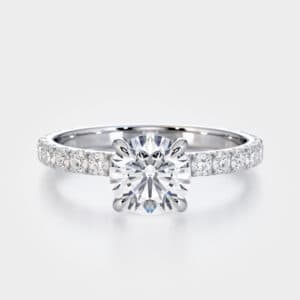
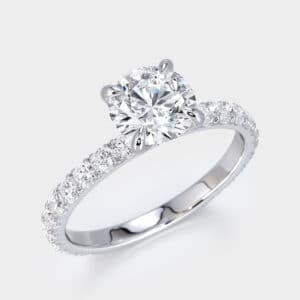
Pave and twisted band: A round solitaire on a pave or twisted pave band keeps the minimalist profile of a solitaire while adding continuous sparkle along the shank. The center stone reads as clean and prominent; the band adds brilliance without a halo’s additional visual width. See our Round Lab Diamond Twisted Pave Ring.
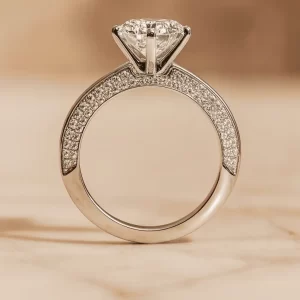
Cathedral solitaire: The band arches upward on both sides to meet the setting, elevating the center stone above the finger. The elevated position shows more of the stone’s profile and creates a dramatic, architectural look. See our Round Lab Diamond Cathedral Solitaire.
Lab grown diamonds are chemically, physically, and optically identical to mined diamonds — same carbon crystal structure, same hardness of 10 on the Mohs scale, same refractive index, same light performance. The only difference is origin: lab diamonds are grown in a controlled environment rather than extracted from the earth. They come with the same IGI and GIA certifications as mined stones, graded on the same color, clarity, cut, and carat scale.
For round brilliants specifically, the price difference between lab and mined has become significant — particularly at 2 carats and above, where mined diamond prices increase sharply. A 2ct Ideal cut round brilliant in F/VS1 that would cost $15,000–$20,000 as a mined stone can be purchased as a lab diamond for $2,000–$3,500. The visual result, the certification, and the wearing experience are identical.
At Ariel Jewellery, every lab diamond we offer is IGI certified and selected for its cut quality. We do not sell lab rounds below Ideal cut — cut grade is the most important variable, and we do not compromise it.
The most commonly purchased round brilliant engagement rings globally fall in the 1.0 to 1.5 carat range. In the United States, the average is approximately 1.0 to 1.2 carats. However, with lab diamonds bringing the cost of larger stones within reach of a much wider range of buyers, 2ct and above has become significantly more accessible than it was five years ago.
Both grades represent the top tier of cut quality for round brilliants, using the same proportion ranges established by Tolkowsky’s research. GIA grades round brilliants as Excellent, Very Good, Good, Fair, or Poor. IGI uses Ideal, Excellent, Very Good, Good. A GIA Excellent and an IGI Ideal round brilliant cut to the same proportions are equivalent — both indicate the diamond was cut for maximum light performance. For lab grown diamonds, IGI is the most commonly used certification laboratory and their Ideal grade is the standard to look for.
Yes, typically. Round brilliants command a price premium over fancy shapes (oval, cushion, pear, emerald, etc.) of roughly 10–30% for equivalent carat weight, color, and clarity. The premium exists for two reasons: round brilliants produce more waste during cutting (the rough diamond crystal is not naturally round), and demand for round brilliants is consistently higher than for any other shape. If budget is the primary constraint, an oval or cushion cut will deliver more visible carat weight per dollar — but the optical performance of the round brilliant is unmatched.
Round brilliants look excellent in every metal, which is part of their versatility. In white gold or platinum, the cool neutral metal allows the colorless qualities of the diamond to dominate — particularly flattering for D–G color grades. In yellow or rose gold, the warm metal creates a strong contrast with the white diamond that makes both elements appear more vivid. G–H color grades are the sweet spot for yellow and rose gold settings, as the warm metal makes the near-colorless stone appear completely white.
The most reliable method is to purchase a certified diamond — IGI or GIA — with an Ideal or Excellent cut grade on the certificate. The cut grade on the certificate reflects a laboratory assessment of the stone’s proportions, symmetry, and polish against established optimal ranges. Beyond the certificate, an Ideal cut round brilliant will look visibly more brilliant and lively under standard lighting conditions than a comparable stone with a lower cut grade. If you are purchasing in person, compare stones side by side under consistent lighting — the difference between Ideal and Good cut is visible without training.
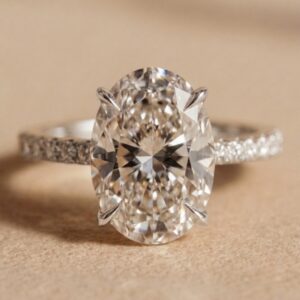
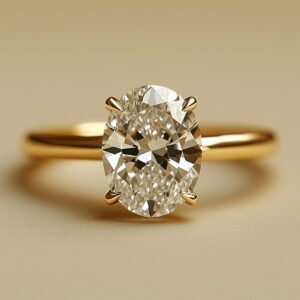
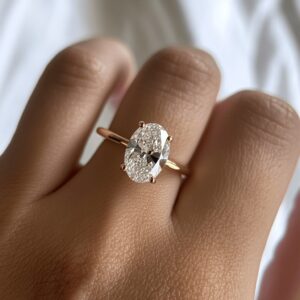
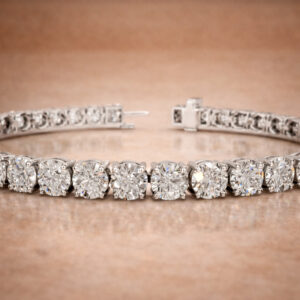
Find Your Size & Ring Match with Our Guide Size Chart
If you would like to measure your ring size immediately the quickest ways and with an accurate fit – you can do it with our Ring Size Chart here.
The way to quickly get your measurements is either going to the nearest jewelry shop and ask them to measure you, or to buy a Ring Sizer Measuring Gauge with a 2-day delivery to the US!
Then you can match your measurement to the size chart below to get your exact ring size.
A few factors we recommend to consider for the perfect measure:
Still not sure what your size is or what to choose for your love one? We’re here to help!
| MM | Inches | MM | Inches | UK/AU | US & Canada & Mexico | France | Germany & Russia & Ukraine & Asia | India & China & Japan & South America | Italy & Spain & Netherlands & Switzerland |
| 14.05 | 0.553 | 44.14 | 1.74 | F | 3 | 44 | 14 | 4 | 4 |
| 14.25 | 0.561 | 44.77 | 1.76 | F 1/2 | 3.25 | 44.625 | 14.25 | 4.5 | 4.625 |
| 14.45 | 0.569 | 45.4 | 1.79 | G | 3.5 | 45.25 | 14.5 | 5 | 5.25 |
| 14.65 | 0.577 | 46.02 | 1.81 | H | 3.75 | 45.875 | 14.75 | 6 | 5.875 |
| 14.86 | 0.585 | 46.68 | 1.84 | H 1/2 | 4 | 46.5 | 15 | 7 | 6.5 |
| 15.04 | 0.592 | 47.25 | 1.86 | I | 4.25 | 47.125 | 15.25 | 7.5 | 7.125 |
| 15.27 | 0.601 | 47.97 | 1.89 | I 1/2 | 4.5 | 47.75 | 15.5 | 8 | 7.75 |
| 15.53 | 0.611 | 48.79 | 1.92 | J 1/4 | 4.75 | 48.375 | — | 8.5 | 8.375 |
| 15.7 | 0.618 | 49.32 | 1.94 | J 1/2 | 5 | 49 | 15.75 | 9 | 9 |
| 15.9 | 0.626 | 49.95 | 1.97 | K 1/4 | 5.25 | 49.625 | 16 | 9.5 | 9.625 |
| 16.1 | 0.634 | 50.58 | 1.99 | L | 5.5 | 50.25 | 16.25 | 10 | 10.25 |
| 16.3 | 0.642 | 51.21 | 2.02 | L 1/4 | 5.75 | 50.875 | — | 11 | 10.875 |
| 16.51 | 0.65 | 51.87 | 2.04 | M | 6 | 51.5 | 16.5 | 12 | 11.5 |
| 16.71 | 0.658 | 52.5 | 2.07 | M 1/2 | 6.25 | 52.125 | 16.75 | 12.5 | 12.125 |
| 16.92 | 0.666 | 53.16 | 2.09 | N | 6.5 | 52.75 | 17 | 13 | 12.75 |
| 17.13 | 0.674 | 53.82 | 2.12 | N 1/2 | 6.75 | 53.375 | — | 13.5 | 13.375 |
| 17.35 | 0.683 | 54.51 | 2.15 | O | 7 | 54 | 17.25 | 14 | 14 |
| 17.45 | 0.687 | 54.82 | 2.16 | O 1/2 | 7.25 | 54.625 | 17.5 | 14.5 | 14.625 |
| 17.75 | 0.699 | 55.76 | 2.2 | P | 7.5 | 55.25 | 17.75 | 15 | 15.25 |
| 17.97 | 0.707 | 56.45 | 2.22 | P 1/2 | 7.75 | 55.875 | — | 15.5 | 15.875 |
| 18.19 | 0.716 | 57.15 | 2.25 | Q | 8 | 56.5 | 18 | 16 | 16.5 |
| 18.35 | 0.722 | 57.65 | 2.27 | Q 1/2 | 8.25 | 57.125 | 18.25 | 16.5 | 17.25 |
| 18.53 | 0.729 | 58.21 | 2.29 | Q 3/4 | 8.5 | 57.75 | 18.5 | 17 | 17.75 |
| 18.69 | 0.736 | 58.72 | 2.31 | R 1/4 | 8.75 | 58.375 | 18.75 | 17.5 | 18.375 |
| 18.89 | 0.748 | 59.34 | 2.35 | R 3/4 | 9 | 59 | 19 | 18 | 19 |
| 19.22 | 0.757 | 60.38 | 2.38 | S 1/4 | 9.25 | 59.625 | 19.25 | 18.5 | 19.625 |
| 19.41 | 0.764 | 60.98 | 2.4 | S 3/4 | 9.5 | 60.25 | 19.5 | 19 | 20.25 |
| 19.62 | 0.772 | 61.64 | 2.43 | T 1/4 | 9.75 | 60.875 | 19.75 | 19.5 | 20.875 |
| 19.84 | 0.781 | 62.33 | 2.45 | T 1/2 | 10 | 61.5 | 20 | 20 | 21.25 |
| 20.02 | 0.788 | 62.89 | 2.48 | U | 10.25 | 62.125 | 20.25 | 21 | 22.125 |
| 20.2 | 0.797 | 63.46 | 2.5 | U 1/2 | 10.5 | 62.75 | 20.5 | 22 | 22.75 |
| 20.44 | 0.805 | 64.21 | 2.53 | V 1/4 | 10.75 | 63.375 | — | 22.5 | 23.375 |
| 20.68 | 0.814 | 64.97 | 2.56 | V 1/2 | 11 | 64 | 20.75 | 23 | 24 |
| 20.85 | 0.821 | 65.5 | 2.58 | W 1/4 | 11.25 | 64.625 | — | 23.5 | 24.625 |
| 21.08 | 0.83 | 66.22 | 2.61 | W 3/4 | 11.5 | 65.25 | 21 | 24 | 25.25 |
| 21.24 | 0.836 | 66.73 | 2.63 | X 1/4 | 11.75 | 65.875 | — | 24.5 | 25.875 |
| 21.49 | 0.846 | 67.51 | 2.66 | Y | 12 | 66.5 | 21.25 | 25 | 26.5 |
| 21.69 | 0.854 | 68.14 | 2.68 | Y 1/2 | 12.25 | 67.125 | 21.5 | 25.5 | 27.125 |
| 21.89 | 0.862 | 68.77 | 2.71 | Z | 12.5 | 67.75 | 21.75 | 26 | 27.75 |
| 22.1 | 0.87 | 69.43 | 2.73 | Z +1/2 | 12.75 | 68.375 | — | 26.5 | 28.375 |
| 22.2 | 0.75 | 70 | 2.74 | Z+1 | 13 | 69 | 22 | 27 | 29 |
Simply enter LAUNCH10 at checkout to redeem your discount. Don’t miss out on this limited time offer!